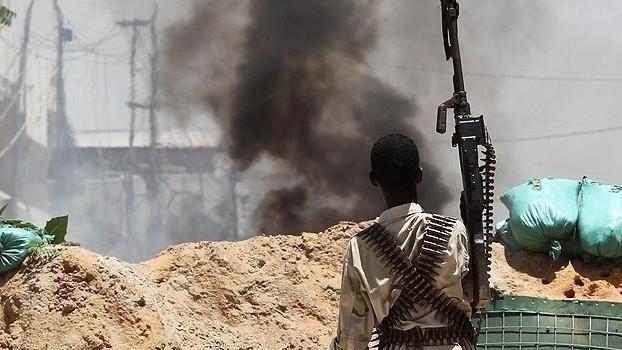
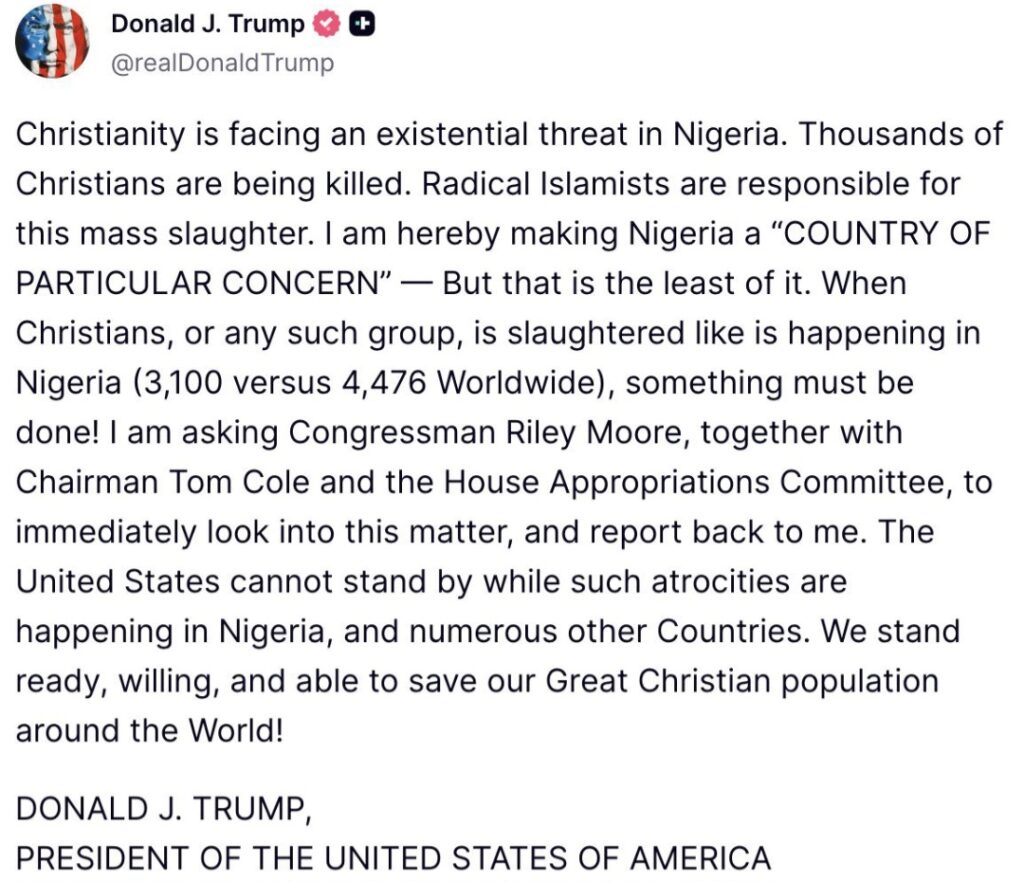
President Trump announced he has instructed the United States Department of Defense (UD D) to “prepare for possible action” in Nigeria, accusing the Nigerian government of “allowing the killing of Christians.”
He said the U.S. would immediately stop all aid and assistance to Nigeria if the government fails to act.
In his message on social media he used strong language:
“We may very well go into that now disgraced country, ‘guns-a-blazing,’ to completely wipe out the Islamic Terrorists who are committing these horrible atrocities.”
He also placed Nigeria on the “Countries of Particular Concern” (CPC) list for alleged severe violations of religious freedom.
Why it matters
Nigeria is a major U.S. partner in West Africa, both for economic reasons (oil, demographics) and security cooperation.
The claim of large-scale targeting of Christians in Nigeria is highly contested: independent analysts say violence affects Christians and Muslims, and often has overlapping causes (banditry, herders/farmers conflict, ethnic clashes).
The threat of military action from the U.S. raises big issues: it touches on Nigeria’s sovereignty, diplomatic relations, international law, and the nature of foreign aid/effectiveness.
How Nigeria responded
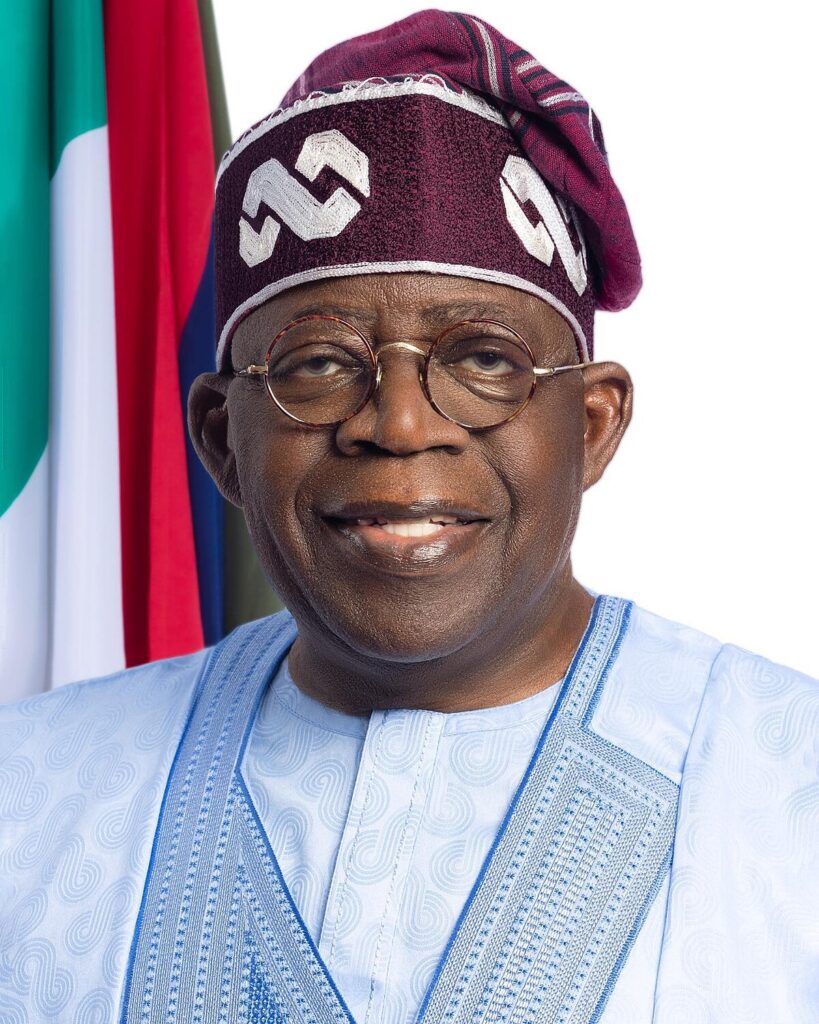
Bola Ahmed Tinubu, President of Nigeria, stated that the claim of religious intolerance “does not reflect our national reality”, and affirmed that the government works to protect freedom of religion for all faiths.
The regional bloc Economic Community of West African States (ECOWAS) rejected the U.S. claim that Nigeria allows terrorists to kill Christians, calling the narrative “false and dangerous” and stressing that violence in the region targets people of all faiths.
Key points and considerations
The U.S. designation of Nigeria as a CPC can pave the way for sanctions, restrictions on aid, and diplomatic pressure. “CPC” is a classification under the International Religious Freedom Act.
The language used (“guns-a-blazing”, “wipe out the Islamic Terrorists”) is unusually direct and militaristic for U.S. foreign policy statements, especially since it names Nigeria—a sovereign nation—as a potential target of U.S. action.
Nigeria’s internal security problems are complex: insurgency in the northeast (e.g., Boko Haram), banditry in the northwest/centre, communal and religious tensions, resource conflicts. Christian persecution is one facet, but not the only or necessarily the dominant one.
For Nigeria the stakes are high: losing U.S. aid, facing potential military intervention, or seeing severed diplomatic ties could worsen internal security conditions, economy, and foreign relations.
For the U.S., this statement may reflect domestic political pressures (evangelical voter base, Christian persecution narratives), but a military intervention in Nigeria would be extremely complex and carry significant risks and costs.
What to watch next
Whether Nigeria’s government will engage diplomatically with the U.S. to de-escalate the situation and seek a joint counter-terrorism strategy.
If the U.S. actually moves from threat to concrete action: changes in aid, imposition of sanctions, or military deployment or air strikes.
How regional actors (ECOWAS, Nigeria’s neighbours) respond and whether they will rally around Nigeria or shift strategies.
Independent evidence and reporting on the scale and nature of violence in Nigeria: whether Christians are being specifically targeted, or whether the violence is more evenly distributed and driven by other factors.
Domestic responses in Nigeria: political mobilisation, public opinion, impact on relations between Christian and Muslim communities.